Cooling tower, Bavaria
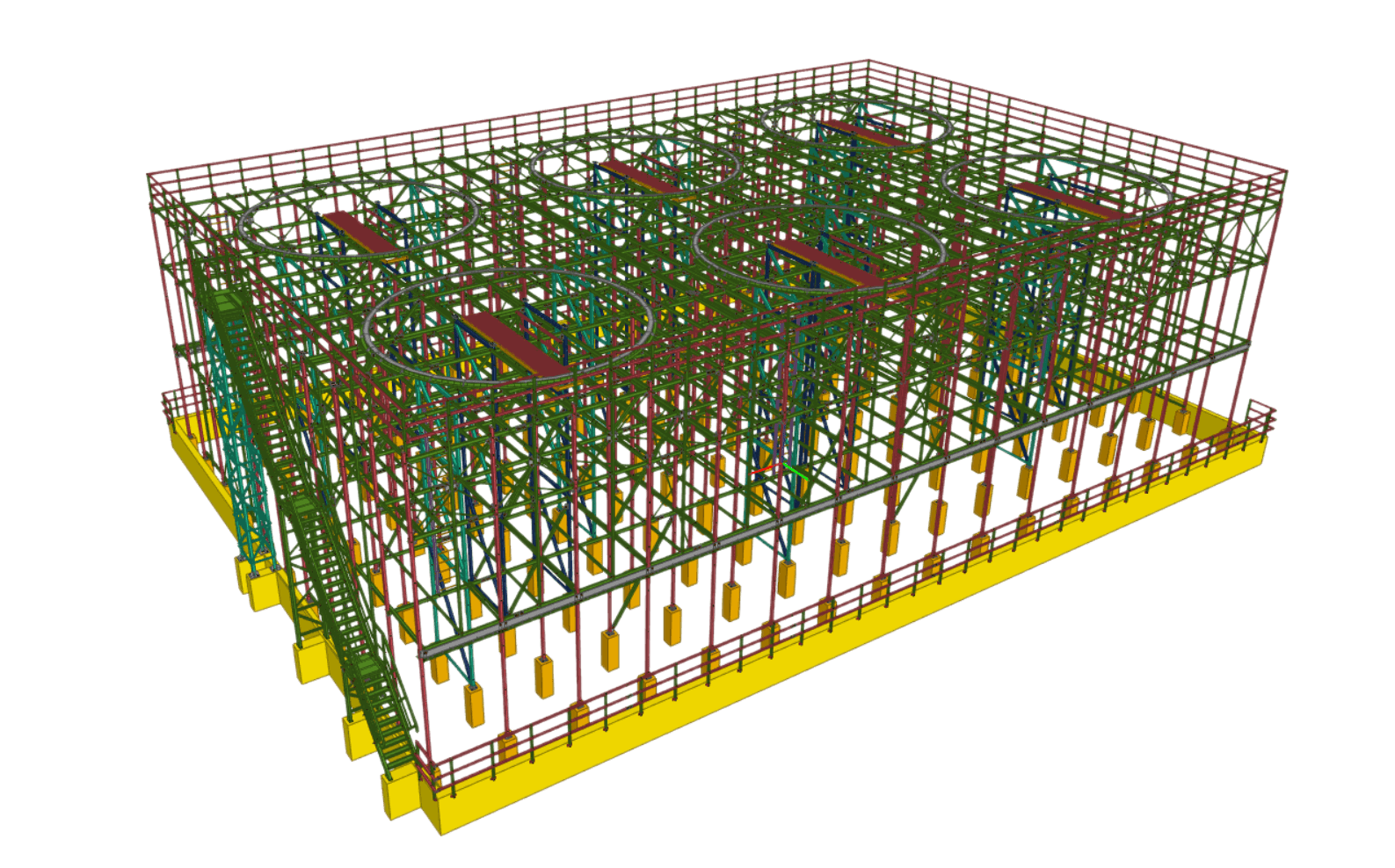
Our engineering firm planned a steel structure for the expansion of a cooling tower at an industrial site in Bavaria. The goal of the project was to design a stable and durable construction that meets the specific environmental and operational requirements of the cooling tower. Key factors included precise integration with the existing buildings and strict adherence to safety standards. The structure was designed to withstand extreme weather conditions and the thermal loads generated during the operation of the cooling tower.
Challenges
Planning and implementing the cooling tower building posed the challenge of meeting high structural and complex safety requirements. The new steel structure had to be seamlessly integrated into the existing cooling tower framework. This required precise alignment with existing structures and consideration of possible deformations and material aging. The site in Bavaria is subject to changing weather conditions, so the steel structure had to be dimensioned and planned to withstand both the thermal stress from the cooling tower’s waste heat and the local climate conditions.
01.02.2020 - 01.05.2020
Adress:
Bayern, Deutschland
Project phases
Requirements Analysis
In the first phase, the technical requirements and specifications for the steel building were defined. Together with the client, we conducted a detailed analysis of operational needs and local site conditions. This analysis formed the basis for subsequent planning and construction and helped us develop a cost-effective and safe design concept.
Surveying with 3D Laser Scanning
To ensure an accurate representation of the existing buildings and their surroundings, we used state-of-the-art 3D laser scanning technology. This method allowed for precise surveying and delivered a high-resolution digital model of the environment. Laser scanning ensured that all details and potential problem areas were identified early.
As-Built Modeling
Based on the scan data, a digital model of the existing building was created. This model enabled us to document all relevant building components and their conditions. As-built modeling ensured that the new steel structure could be optimally adapted to the existing construction.
Design – Service Phase 3 (LPH 3)
During the design phase, we developed several structural design options and conducted structural calculations to ensure the load-bearing capacity and stability of the structure. All relevant standards and guidelines were taken into account. In close coordination with the client, the final design was selected to provide an optimal balance between functionality and cost-effectiveness.
Approval – Service Phase 4 (LPH 4)
The final design was prepared for the approval process and submitted to the responsible authorities for review. We accompanied the entire approval process and maintained close communication with the authorities to ensure all legal requirements were met. This allowed the approval to proceed smoothly and efficiently.
Implementation Planning – Service Phase 5 (LPH 5)
In this phase, the final implementation plan was created. The detailed planning included all necessary information for executing the project, such as construction drawings, material specifications, and assembly instructions. The implementation planning ensured that the steel structure could be built to the highest quality standards and according to the specified design.
Galery
Hauptansicht

Ansicht Rechts

Draufsicht

Treppe

Befestigung von Einzelkühltürmen

Dachgelände und Übergangspodest